


ATHENS, Ga. — Artificial intelligence is becoming an increasingly large part of the poultry industry, and one college professor is using it to prepare his students for the workforce. Andrew Benson, associate professor of poultry science at the University of Georgia, is using AI chatbots to give his students a more in-depth understanding of the poultry industry.
“In my class, traditionally, we talk about the industry and how it’s structured,” Benson said. “I always felt like I wasn’t giving them the true complexity of the poultry industry, and I think I was selling them short in terms of how it’s really shaped by several different stakeholders and some of them have competing priorities.”
To give his students these stakeholders’ viewpoints, Benson developed four different role-playing chatbots with which they could interact. The personas include a contract broiler farmer, a CEO, an environmentalist and an animal welfare advocate.
Benson chose these stakeholders specifically because, to him, their “perspectives really drive and shape decisions in the poultry industry.”
Once the personas were created, the students began engaging with them.
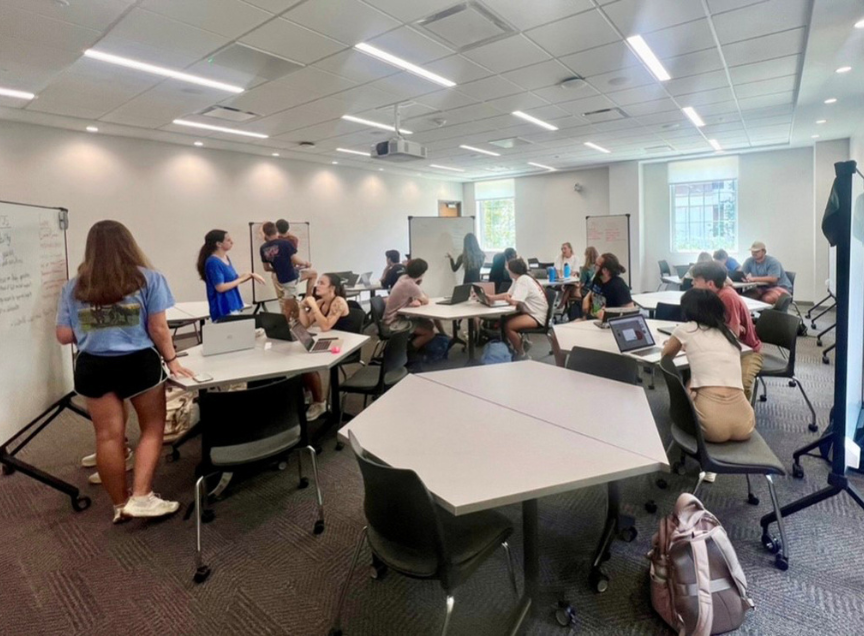
Students were assigned a stakeholder role and then talked with the chatbot to learn that stakeholder’s point of view. Benson gave them a topic to discuss, and, after some time, the class came together as a group and compared what each stakeholder thought about the chosen topic.
“The first debate, so to speak, is about the vertical integration model,” Benson said. “So, what does the contract farmer see as an advantage of the vertical integration model? What do they see as disadvantages? How does the CEO see that? And what are the concerns and advantages for environmentalist and animal welfare?”
After initial comparisons, Benson paired students together to critique the advantages and disadvantages of each stakeholder. This way the students could get deeper into the mindset of the industry in a way that hadn’t been done before.
Benson initially started using generative AI in his class at the beginning of the spring 2024 semester. What started off as an exercise to give his students various stakeholder perspectives, quickly became a permanent fixture in his curriculum.
“I thought it would be just a standoff, but my first semester of using it, I kept bringing them back in. We would talk about different management issues … a lot of, kind of, current issues,” Benson noted. “I wanted them to appreciate how other perspectives view these issues.”
“By appreciating other perspectives and having empathy for those perspectives, I think it … gives them a better position to formulate their own opinion,” Benson continued.
Preparing students for the future
Now that it’s been more than a year since Benson started using chatbots in his class, he wants his students to become more comfortable and confident using them.
“I don’t know where generative [AI] is going, but I want them to be responsible and authentic users of it,” Benson explained. “So, one thing I’m working on this semester is they themselves are going to build their own stakeholder bots. So, they’ll interview a contract farmer, CEO environmental group, animal welfare group.”
With this exercise, the students get more first-hand experience using generative AI.
Although the AI chatbots were originally brought in to prepare students for their futures in the poultry industry, they are also addressing issues graduates have when starting in the industry.
“We always want to make sure our graduates are fulfilling what we think we should be fulfilling, which is to become leaders and major players in the industry,” Benson said. “Some of the feedback we get [is] it’s not a content issue; it’s more of critical thinking and soft skills.”
While students have a grasp on the basics of the poultry industry, they struggle with problem solving and decision making. But now with the help of AI, Benson can focus more of his class time on active learning activities that work on the “skills that the industry said they would like to see better developed in our graduates,” rather than just delivering content.
AI has become such a hot button topic recently, but Benson makes his stance clear.
“It can work as a really good assistant in generating ideas or potentially troubleshooting, but … I hope we remain with a person in the driver’s seat,” Benson said. “That we work with it as a tool and not as a replacement. So, I want my students to know that tool, because I think that tool is going to be prevalent and knowing that tool will put them in a better position to be dynamic leaders.”
In the end, it all comes back to his primary reasoning for bringing AI into the classroom: to better prepare his students for a successful future in the poultry industry.
“It’s about giving this generation, who will be the next generation of poultry leaders, the necessary tools and knowledge to take on that role in this future that we all are uncertain about,” Benson noted.
