

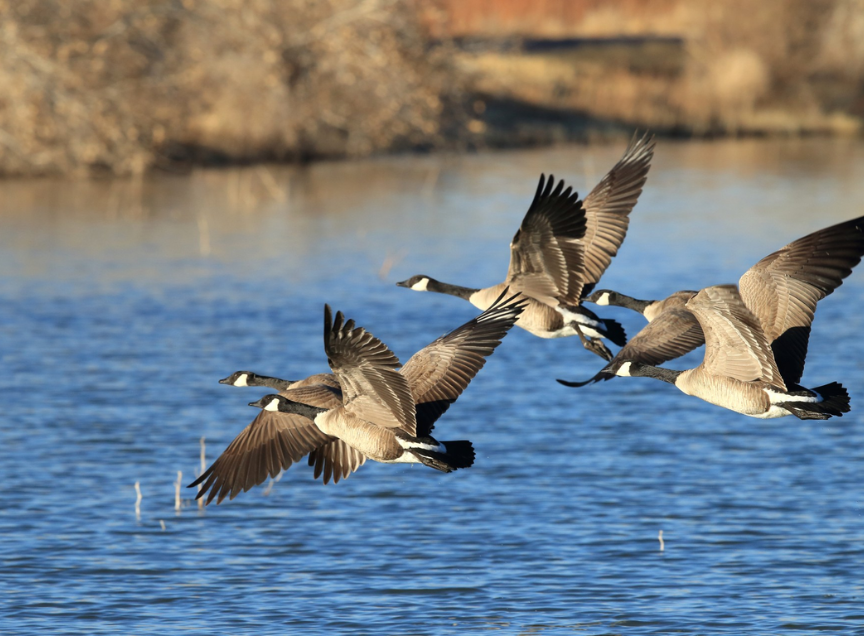

ATHENS, Ga. — Waterfowl, such as ducks and geese, and how and when they settle or migrate, and how this relates to highly pathogenic avian influenza spreads among wild bird populations is viewed in a new study from the University of Georgia.
Birds tend to stay in areas of human activity with abundant shelter, food and water, and travel less distance, which decreases bird flu spread, researchers noted. However, when wild birds remain in one location, that location can become a hotspot of disease.
“Birds are like us. They’re always responding to what’s around them, whether that’s food availability or disturbance from people or other animals,” Dr. Claire Teitelbaum, University of Georgia adjunct assistant professor with the Warnell School of Forestry and Natural Resources and also lead author of waterfowl and bird flu study.
“We can take the environment, predict how much we think birds are moving and then use that to predict where avian flu is going to go,” said Teitelbaum, who is also an assistant unit leader with the U.S. Geological Survey’s Georgia Cooperative Fish and Wildlife Research Unit.
Looking at how waterfowl typically move outside of their natural migration periods could give researchers an enhanced idea of where bird flu may move next, the university said in its study announcement.
For this study, two decades of migration data from more than 4,600 total waterfowl encompassing 26 species in the Northern Hemisphere were considered. They were tracked by distance over time and during winter and breeding seasons, the study noted.
Birds will “commute” between resting and eating areas, and these distances which happened outside of seasonal migration periods were dependent on the environments, the study said, adding that if the birds were in expanses such as farmland or grasslands, they would travel six times farther in their search for food and shelter as opposed to birds that were in more diversified landscapes. These diverse landscapes, which could vary between urban areas to wetlands, did not require the birds to travel a far distance to acquire their food needs.
Birds in areas of human activity would travel about one-third the distance of those in more spread-out locations, the researchers added. These human areas played a role, because they often provided places for shelter, sources of water, as well as areas that offered protection.
“If we provide enough diverse attractive habitats, these animals may want to stick around,” Teitelbaum said.
“Like humans, if you live in a suburban neighborhood where it’s just single-family homes for miles and miles, you’re going to have to drive miles and miles out of that area to get to work or shop,” Teitelbaum added. “If you live in an urban center, you have everything you need right there.”
Researchers have now been studying for years how the seasonal migration times affect the bird flu spread with wild waterfowl. But this new study investigated how flight patterns during the winter and breeding seasons also impact the movement of the virus. The movements were twice as far during the winter compared to the breeding season, the study noted, and the birds were often reported flying farther to find their food and shelter, meaning that they could potentially be carrying the virus along with them on these distances.
When looking and daily and weekly movements, the same patterns were reported, the study says. This is a key factor, Teitelbaum noted, because the incubation period for the virus is one week.
“If we want to keep the flu from spreading, we might want to see what we can do to keep the birds in one place, but there’s that flipside,” she said. “Outbreaks happen when birds are in high density, so we might have increased transmission locally.”
“That’s the underpinning,” Teitelbaum added. “How can we link the distances that birds are moving to the distances that flu is moving?”
