

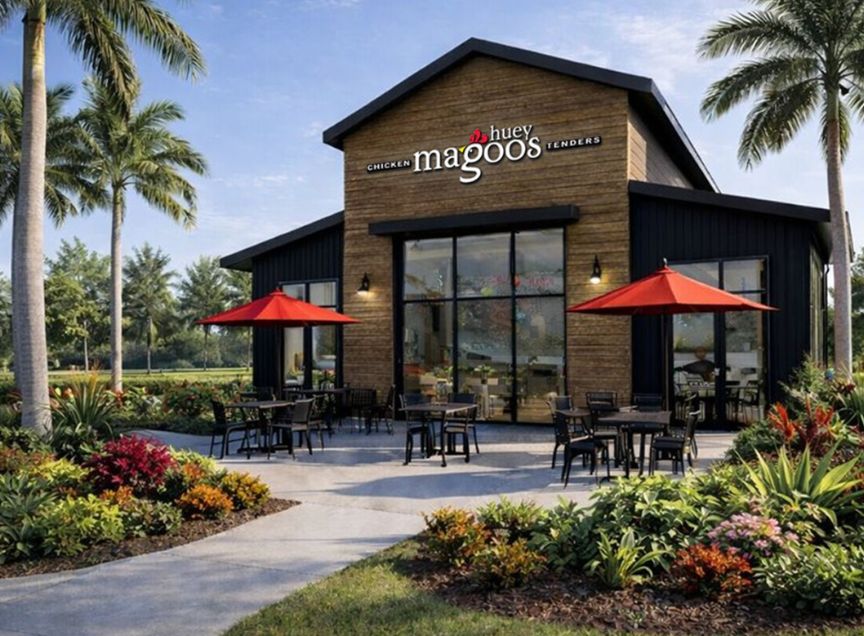

ORLANDO, Fla. — Huey Magoo’s is introducing a free-standing drive-thru prototype designed to lower build costs and increase site flexibility for franchisees, the company said, adding that the design allows development on sites that were previously not viable, supporting growth in more markets while reducing upfront investment.
The prototype extends the brand’s design approach into a stand-alone drive-thru format, building on momentum from 2025, when Huey Magoo’s introduced a condensed 1,500-square-foot inline model to reduce buildout costs and expand access to high-traffic retail centers, the company added in its announcement. That format created a more economical path for franchisees while maintaining the full guest experience, laying the groundwork for continued design innovation. This new drive-thru prototype, designed for smaller parcels around 0.5 acres, the new layout further maximizes space efficiency while preserving the in-restaurant experience.
“We’re excited to introduce an option for current and future franchisees interested in building from the ground up,” Andy Howard, Huey Magoo’s president and CEO, said. “With rising costs across real estate and construction, we’ve focused on creating a scalable, cost-effective design that makes development more accessible for franchisees while maintaining the core brand experience.”
This format measures approximately 1,850 square feet, plus an outdoor cooler. At 40 feet wide by 50 feet deep, it is designed to fit typical half-acre parcels and includes seating for 37 guests indoors and 18 on an exterior patio, along with a dedicated drive-thru lane. Compared with the brand’s current free-standing prototype, which is approximately 2,600 square feet with 42 seats, the design achieves a more efficient layout while maintaining seating capacity, the company said, adding that the result is a smaller footprint, along with an estimated 40 percent reduction in ground-up development costs.
Designed in-house by Melissa McCammack, Huey Magoo’s director of architecture and design, the prototype reflects the brand’s continued investment in its restaurant design to support long-term growth. By bringing architecture and design in-house, the brand can evaluate sites in real time, create test fits and develop solutions for a wider range of locations, the company said.
“Our goal was to develop a prototype that prioritizes efficiency,” McCammack said. “By refining the layout and focusing on how guests and team members move through the space, we reduced the overall footprint while maintaining an open and comfortable environment.”
The design also improves the flow of the kitchen, dining, and ordering areas by minimizing unnecessary circulation and excess volume. A centralized ordering area anchors the space within a larger, more open volume, with dining areas positioned along the perimeter wings. This approach reduces the overall building mass while also allowing mechanical systems to be more discreetly integrated, Huey Magoo’s added.
The exterior design features a pitched roofline and a prominent central façade with expansive windows that bring natural light into the dining area. A mix of wood siding, paneling, and dark trim creates a modern farmhouse inspired aesthetic, blending warmth with a clean, contemporary edge, the company noted.
Additional features include a fully digital menu board system that allows for centralized updates and flexibility across locations. The building is also designed to accommodate additional storage or cooler space based on operational needs, the company said.
Huey Magoo’s operates almost 90 locations in 12 states, and notes that it is on track to pass 100 by the end of the year.
