

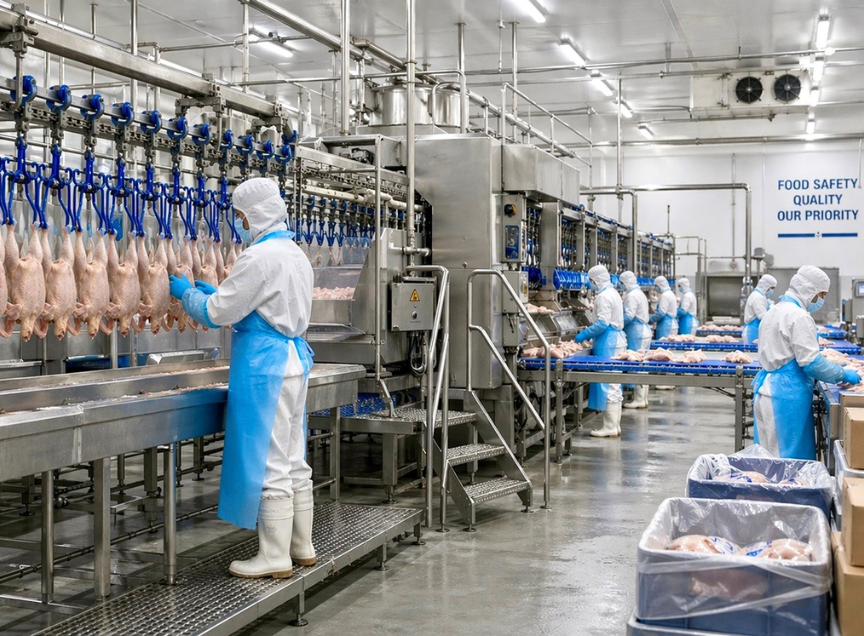

WASHINGTON — Proposals by USDA’s Food Safety and Inspection Service to increase processing line speeds for chicken and turkeys have received comments from poultry industry associations, food safety, and worker safety organizations, as well as governmental officials.
The proposal to amend regulations under the New Poultry Inspection System (NPIS) would allow line speed operation increases for chickens up to 175 birds per minute from 140, and turkey BPMs up to 60 from 55.
“The proposed amendments would allow poultry establishments to slaughter birds more efficiently while continuing to ensure food safety and effective online carcass inspection,” FSIS said.
The comment period officially ended on April 20 and industry groups both for and against the proposals submitted commentary.
The National Chicken Council has voiced its staunch support for the proposed rules.
“This is a science-based rule backed with decades of data that will make chicken more affordable for American families, create jobs in rural communities, and strengthen U.S. global competitiveness — all while maintaining our industry’s commitment to food and worker safety,” Dr. Ashley Peterson, NCC’s senior vice president of scientific and regulatory affairs, said.
“For almost 30 years, rigorous research and real-world data have consistently demonstrated that poultry processors can safety and effectively operate evisceration lines at 175 birds per minute,” Peterson added. “We applaud (USDA Agriculture Secretary Brooke Rollins) and FSIS for their common-sense approach and encourage the agency to move quickly to make this rule final.”
Regarding food safety, the increased line speeds would also meet standards requirements for Salmonella reduction, Peterson wrote in her comments to Dr. Justin Ransom, FSIS administrator.
“FSIS acknowledged in the proposed rule that Salmonella prevalence and other indicators of process control were not significantly increased at establishments operating at higher line speeds compared to those operating at or below 140 bpm,” NCC said in its release. “Since NPIS line speed waivers were first approved in 2017, there has been a 9.2 percent decrease in the number of Salmonella illnesses per 1 million pounds of chicken consumed.”
“In other words, higher line speeds do not lead to higher rates of Salmonella or increased contamination during processing,” Peterson wrote in her comments to FSIS.
She also cited data that shows worker injuries in poultry processing in the past 30 years are 90 percent less, and that the efficient running of the lines could lead to the need for additional employees, as well as product price affordability.
“Increased line speeds will also deliver meaningful benefits to the farmers who raise America’s chickens,” Peterson wrote in her comments. “Greater processing throughput allows growers to move more flocks to market, improving farm cash flow and operational planning. For the thousands of independent contract growers and family farm operations that form the backbone of the American poultry industry, this translates into great economic stability. A more efficient processing system supports the entire supply chain — from the farmer raising flocks in rural America to the family purchasing chicken at their local grocery store.”
The National Turkey Federation also notes its support for increasing turkey lines to 60 BPM but adds concerns regarding inspector-in-charge (IIC) authority in reducing speeds and is open for increased data collection.
“NTF … requests that FSIS remain open to considering eliminating line speed limits in the future when there has been more data gathered from NPIS establishments operating at 60-bpm maximum,” Dr. Lindy Froebel, NTF’s senior vice president of science and policy, wrote in comments to FSIS. “NTF would prefer that establishments be permitted to establish their own line speed limits that match their capability to maintain process control and permit carcass-by-carcass inspection. This model is the approach in the European Union. NTF recognizes that data for turkey establishments is currently limited. Therefore, we support additional data collection to determine if the maximum line speed may be increased beyond the currently proposed rate.”
“Should the agency move forward with a Final Rule, to ensure consistency and transparency, NTF urges FSIS to clearly define when an IIC may direct line speed reductions,” she added.
“The Meat Institute has supported changes to line speed rules for pork and poultry processing through four administrations,” Julie Anna Potts, Meat Institute president and CEO, also said in a statement earlier this year. “We applaud the leadership of the Trump administration in what we hope will be the final action to modernize FSIS rules and procedures to allow for innovation in processing and to increase production.”
For the federal Senate and House, earlier this year, U.S. Sen. John Boozman (R-Ark.), chairman of the Senate Committee on Agriculture, Nutrition and Forestry; and U.S. Rep. Glenn (GT) Thompson (R-Pa.), chairman of the House Committee on Agriculture, issued a joint statement on the proposed processing line speed increases.
“We are pleased to see USDA take this next step to modernize and provide much needed certainty to our pork and poultry supply chains,” Boozman and Thompson wrote. “America’s meat and poultry companies continue to set the gold standard worldwide for food and worker safety. These proposed rules, grounded in decades of research, will ensure our regulatory system reflects the latest science by establishing a long-term pathway for eligible producers to operate at increased line speeds, improving efficiency while maintaining the same rigorous food and worker safety standards.”
The United Food and Commercial Workers International Union (UFCW) has expressed its opposition to the proposed line speed rules.
“Throughout this public comment period, UFCW members made clear to the USDA that increased line speeds risk setting their workplace back decades,” Mark Lauritsen, UFCW international vice president and director of its food processing, packing and manufacturing division, said in a statement. “Meatpacking workers know the potential impact of this proposed rule better than any elected official, bureaucrat, or industry talking head.”
“From the beginning, this proposed rule has been in service to the bottom line of the big meatpackers,” Lauritsen added. “It flies in the face of the USDA’s own studies about the impact of line speeds on workers in poultry and pork, and will do nothing to lower prices like the administration claims.”
Also opposed to the new proposed line speed rules is the Safe Food Coalition which sent its own comment letter to Dr. Mindy Brashears, USDA under secretary for food safety.
“These changes would encourage industry to operate in a manner that increases food safety risk at a tine when the proportion of foodborne illnesses attributable to poultry has grown dramatically,” the Safe Food Coalition wrote. “They would take effect after FSIS has abandoned product standards for Salmonella in poultry that the agency spent years to develop, in response to decades of regulatory dysfunction.
“FSIS should not take further action to deregulate poultry processors until it has enacted enforceable, science-based standards to control dangerous Salmonella in poultry and the agency can assure that its actions will not exacerbate treacherous working conditions in poultry plants that undermine food safety.”
