


LAWRENCEVILLE, Ga. — Consistently delivering feed conversion, flock uniformity and growth performance becomes more challenging when every flock brings a different mix of feed, health and management pressure. With the launch of AvrXPrime, Anitox is expanding its poultry portfolio with a new monoglyceride technology designed to complement early-stage nutrition strategies in poultry production.
AvrXPrime will be officially introduced during the joint 2026 World’s Poultry Congress and Poultry Science Association Annual Meeting in Toronto and reflects growing industry interest in understanding not only how birds respond to challenges but the role of early nutritional factors in shaping gastrointestinal conditions before the challenge occurs.
According to Dr. Alastair Thomas, Global Head of Poultry Nutrition & Health at Anitox, the conversation around gut health is evolving.
“Historically, much of the industry’s attention has been directed toward managing challenges once they appear,” says Thomas. “What we’re interested in today is understanding the foundations that help birds maintain performance when those pressures inevitably arise.”
That shift is occurring at a time when producers face continued pressure to improve feed efficiency, flock uniformity and overall economic performance while navigating complex production systems.
“Continued movement toward antibiotic-free production, persistent enteric disease pressure and ongoing feed-cost volatility have increased the importance of maintaining performance under commercial conditions. While producers still seek improvements in growth and feed efficiency, many are focused on reducing variability and protecting performance when conditions are less than ideal. In that environment, the conversation is gradually shifting from how to maximize performance under controlled conditions to how to maintain performance consistently across a wide range of production challenges.”
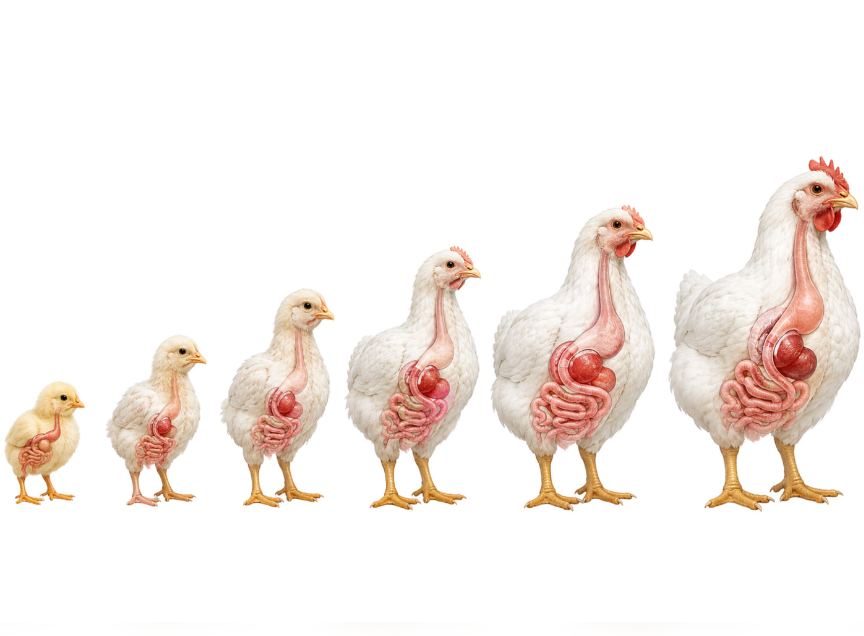
For Thomas, one area receiving growing attention is the role of early intestinal development.
“The intestine does far more than digest and absorb nutrients,” he explains. “It also plays an important role in barrier function, immune regulation and overall efficiency. How that system develops early in life can influence how effectively birds utilize nutrients throughout the production cycle.”
Research has shown that the first days and weeks of life represent an important period for gastrointestinal development. While producers have long recognized the importance of gut
health, new technologies are providing deeper insight into the nutritional and management factors associated with intestinal function and overall performance.
This understanding shaped AvrXPrime development.
Rather than focusing solely on external challenges, the technology was developed to complement nutritional strategies in early production phases. Compared with traditional organic acid approaches, monoglycerides remain active across a broader range of gut pH conditions.
Dr. Thomas suggests that this characteristic may extend the presence of monoglycerides across different regions of the digestive tract, contributing to ongoing research into how early nutrition relates to later production outcomes.
“Intestinal capacity doesn’t suddenly appear when birds encounter stress,” says Thomas. “It develops over time. The stronger the intestinal foundation established early in life, the greater the bird’s ability to maintain efficiency under less-than-ideal conditions.”
Part of the interest surrounding AvrXPrime stems from transcriptomic research conducted during the product’s development. The work provided new insight into how intestinal function evolves over time.
“At Day 10, pathway activity suggested increased nutrient metabolism, microbial metabolite utilization and host-microbiome signaling, responses consistent with active intestinal development and early nutrient use. By Day 28, pathway activity shifted toward digestion, nutrient absorption and oxidative balance, reflecting a more mature and functionally efficient intestinal environment.”
As Dr. Thomas explains, the findings suggest that these responses occur in sequence, with early intestinal development helping create the conditions for improved nutrient utilization later in life.
“Traditionally, we’ve evaluated nutritional technologies through outcomes such as body weight gain or feed conversion,” he says. “Those metrics remain important, but we’re now gaining visibility into the processes that influence those outcomes. That gives us a better understanding of how intestinal capacity develops over the production cycle.”
By looking beyond traditional performance measurements, the work helps explain how changes in intestinal function may contribute to later production outcomes.
Anitox partners with feed and food producers worldwide to help produce safer food more efficiently. For more than 40 years, its solutions have supported milling efficiency, pellet quality, feed hygiene and microbial quality. More recently, Anitox has invested in
understanding how managing incoming microbial loads affects production outcomes, particularly during early life stages.
AvrXPrime expands the poultry portfolio beyond feed quality and microbial control, placing focus on a nutritional approach designed to complement early-life feeding programs and support consistency in production outcomes.
“Feed hygiene remains fundamental,” says Thomas. “Producers have made tremendous progress in controlling risks associated with feed and production environments. AvrXPrime allows us to extend that conversation into using enhanced nutrition to support intestinal development, nutrient utilization and overall flock performance.”
Looking ahead, Thomas believes the industry’s understanding of intestinal function and performance will continue to evolve.
“We’re moving beyond simply asking how we respond to challenge,” he says. “Increasingly, we’re asking what factors help birds remain efficient and productive when challenge occurs. Early intestinal development appears to be an important part of that answer.”
As producers continue seeking new ways to improve efficiency, consistency and profitability, understanding factors associated with early gastrointestinal development is becoming a more prominent part of the poultry performance conversation. The growing focus on performance stability under commercial conditions reflects a broader shift toward building intestinal capacity early, rather than responding after performance has already been lost.
AvrXPrime will be officially introduced during the joint 2026 World’s Poultry Congress and Poultry Science Association Annual Meeting in Toronto. To learn more about the science behind the technology and access additional technical resources, visit www.anitox.com.
