

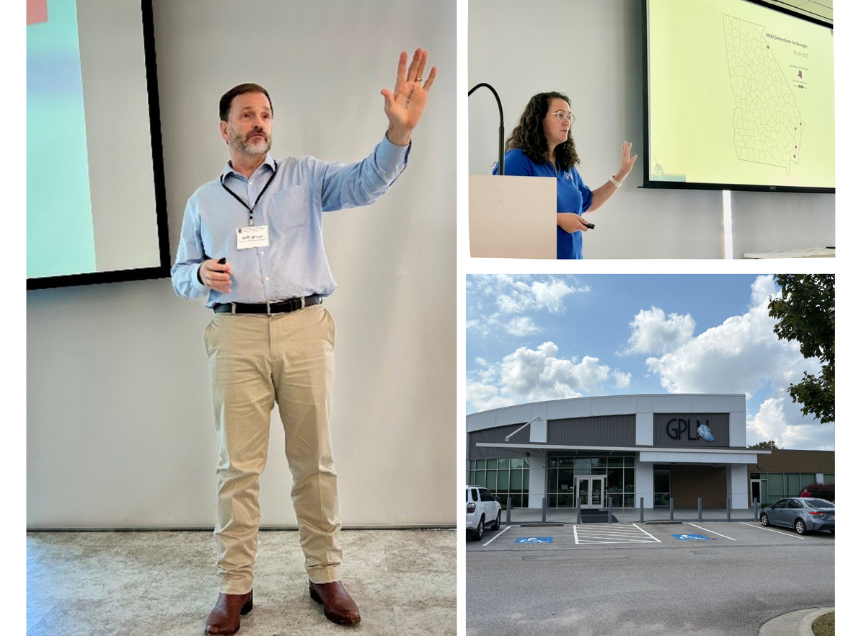

GAINESVILLE, Ga. — The University of Georgia’s Poultry Science Extension recently held its Georgia Layer Conference at the Georgia Poultry Laboratory Network’s headquarters in Gainesville, Ga., in person for the first time in several years after being held virtually since COVID.
At this conference, industry professionals and producers came together to discuss current issues facing table and hatchery egg production specifically. Industry leaders like Deana Jones, Emily Polur, and Jeff Spivey made presentations in their areas of expertise.
It was coordinated by Dr. Lilong Chai, an associate professor and engineering specialist in the Department of Poultry Science at UGA. His research and Extension expertise include climate-smart animal production, precision poultry farming, and poultry health and welfare. In addition to this conference, he is also the coordinator for the Georgia Precision Poultry Farming Conference.
Mike Giles, Georgia Poultry Federation president, opened the conference with an update on the current status of the federation. Among the recent accomplishments for the federation include getting more funding for the GPLN and having a hand in getting a law passed to increase the weight allowed for poultry trucks on the highway.
Originally, this law had a sunset date of July 1, 2025, according to the Georgia General Assembly, but, after passing through the House and the Senate, it is now permanent. The law includes trucks hauling live poultry, feed, and poultry waste and will increase efficiency by 8 percent for poultry producers.
After Giles, Todd Applegate, UGA department head of poultry science, and Casey Ritz, UGA Extension poultry program coordinator, gave updates on the Poultry Science Department and Extension program.
Deana Jones, director of U.S. National Poultry Research Center, gave the first presentation, discussing egg quality and safety management, with a large focus on egg cracks. She has over 20 years of experience inspecting the impacts of egg production practices, shell egg and egg products processing methods, and rules and regulations on egg safety and quality.
Following Jones, Oscar Garrison, the United Egg Producers senior vice president of Food Safety and Regulatory Affairs, gave an overall update on U.S. egg production. Garrison focused on highly pathogenic avian influenza and its impact on the egg industry.
He mentioned that dairy herds infected with HPAI are the biggest threat to eggs. Cows don’t die from bird flu once infected; they simply carry and pass it on to other animals, but dairy cattle can recover from the disease with the right care. So, there isn’t much that can be done to control the spread once a herd is infected.
Poultry disease update
To end the morning session, Emily Polur provided an update on current poultry diseases in Georgia. Polur is the veterinary director and a poultry veterinarian with the GPLN. She recently moved to the Gainesville lab, where she primarily necropsies sick birds, visits problem farms for local industry, and conducts epidemiological investigations in disease outbreaks.
Just like with Garrison, a majority of Polur’s update focused on HPAI. She gave an overview of this current outbreak that started back in 2022 before diving deeper into the confirmations this year.
“2024 was very quiet for us,” Polur said. “We didn’t have any backyard detections, and then boom, beginning of 2025, you have Elbert County. 72 hours after the first call, there was only 250 live birds left in [the] house of 10,000 birds.”
Elbert County ended up having two separate farms with confirmed cases of HPAI in January, with a total of 160,000 affected birds. The entire Elbert outbreak lasted until the middle of February. From this outbreak came a new step in the protocol of returning farms to normal after an outbreak.
“Something new that had popped up was pre-placement biosecurity audits, meaning the farms had to undergo a USDA biosecurity audit in order for birds to be placed back on that farm,” Polur added.
She mentioned the most recent detection in Henry County over Labor Day weekend before moving on to look at the HPAI outbreak on a national scale. Commercial layers have been hit the hardest out of all of the poultry production types this year. So bad in fact that the total number of layers lost has already surpassed last year’s numbers, and it remains to be seen how fall migration will affect the industry.
She wrapped up her discussion on bird flu with a quick mention of recent technologies that could reduce the spread of the virus. The technologies are electrostatic precipitation and UV-C lights.
With electrostatic precipitation, “you charge the dust particles, and then as they are flowing through the air, they get statically attracted to plates, the plates can then be removed, can be cleaned, and the dust particles removed,” Polur said. As for UV-C light, which is germicidal UV light, “when installed appropriately, can reduce high path AI by upwards of 90 percent,” Polur added.
To conclude her presentation, Polur briefly discussed avian metapneumovirus (aMPV) and other diseases seen in poultry recently.
In this recent outbreak of aMPV, it’s been mostly cases of subgroup B with a sprinkle of subgroup A. The clinical signs have varied while some birds are completely asymptomatic when testing positive for the virus.
“There is widespread positivity for metapneumovirus in the East and the Midwest, which is not a shock, because that’s also where all the turkeys and broilers are also getting it,” Polur said.
As for the other diseases, there have been a few cases of spotty liver disease in Missouri, Oklahoma, and Arkansas, and false layer syndrome continues to be a problem with multi-age flocks and pullet facilities. The best way to prevent these diseases is by vaccinating flocks as early as possible.
To start the afternoon session, Nancy Hinkle, UGA’s Department of Entomology’s Extension veterinary entomologist, gave a presentation on mite control in layer houses. She has worked on poultry mites extensively, examining their behavior, host range, acaricide resistance, and alternative treatments.
Her presentation focused on poultry red mites and northern fowl mites, as they are common to both breeders and layers. However, that is only one of the few commonalities between the two. Red mites are nocturnal, mainly found on breeders, and only land on the bird to feed. On the other hand, fowl mites live their entire life cycle on the bird.
Fortunately, neither can live on humans; they can try to feed on humans, but both mites can only survive on avian blood.
Biosecurity management for HPAI
Following Hinkle, Jeff Spivey, director of industry operations and the National Poultry Improvement Plan for the GPLN, gave his presentation on poultry farm biosecurity management. He is responsible for helping the poultry industry in Georgia develop and implement the NPIP 14 principles of biosecurity and audits the industry in Georgia for compliance.
Because of the recent outbreak, his presentation focused on biosecurity measures for HPAI.
“The rule of thumb with AI is [that] the cooler it is, the longer it lasts. Also, keep in mind, they always said a Georgia summer would kill high path AI, that didn’t happen.,” Spivey said.
Although there are 14 principles of biosecurity, the ones he specifically focused on would stop indirect introductions to the virus, not direct.
“You’re composting birds, right? Someone goes out to the stack house, there’ve been vultures around the stack house that are positive,” Spivey said. “They come back to the [main] house, you’re a contract grower, you miss the line of separation, you walk [the virus] in. That’s an indirect introduction.”
“Same thing for equipment and repairs, foot traffic, rodents, and something we don’t see a lot in the Southeast is wind,” Spivey added.
Although it’s not the most exciting topic, he emphasized the importance of biosecurity training. Facilities should be training during orientation and annually. When it comes to records, Spivey mentioned integrating various plans- such as animal welfare and SE prevention plans- into one document and keeping a written record of biosecurity training to prevent any gaps when your company experiences turnover. These are things that could benefit a facility when it comes time for biosecurity audits.
“The rule of thumb here is, if you pass your NPIP biosecurity audit, [and] you get low path or high path AI, you qualify for indemnity and compensation,” Spivey said. “Indemnity will be market payment for the market value of the eggs and the birds. Compensation is clean up and disposal.”
The two major themes of his presentation were the line of separation and controlling people, especially since these two things go hand in hand. For contract growers, in-line operations, and moving from house-to-house, it is important to know your line of separation and define it.
Once the line of separation is known and defined, the staff must be aware of the proper procedures and necessary personal protective equipment.
“What are your procedures to follow from house to house? You’re disinfecting equipment from house to house,” Spivey said. “Moving from house to house in in-line operations, disinfection leading to the birds, critical.
“House dedicated shoes … if you do this on your contract growers, this is the most effective thing,” Spivey added.
A larger part of the line of separation is the perimeter buffer area, which is the zone separating the poultry houses from areas unrelated to poultry production. With the PBA, it’s important to clearly define the entrance and define traffic patterns. It all boils down to distance.
“One of the things we see is distance between birds, vehicles and people,” Spivey noted. “The science says the further you can get people and equipment away from the birds, it’s always better.”
Towards the end of his presentation, Spivey emphasized the importance of developing a culture of compliance and explained the impact wild birds, rodents, and pets can have on one’s operation. He also mentioned the wildlife biosecurity assessment.
“If you’re wanting someone to come on your property, the USDA has a program where our wildlife biologists will come on your property and identify various things,” Spivey said. “You can qualify for certain levels of reimbursement on repairs, access to birds. The biologist will come up with control measures for removing species.”
He ended his presentation with a discussion on proper mortality disposal, permits and testing during a high path AI event.
Housing systems
The conference concluded with a presentation by Claudia Dunkley, a UGA Extension poultry scientist, on laying hen housing systems. Her research program focuses on environmental and waste management issues, including dead bird disposal, litter management, poultry sustainability and greenhouse gas emissions from poultry production.
The four main housing systems are conventional cages, enriched colony cages, aviary housing, and pastured poultry. Conventional cages can be high rise or battery, but battery cages can hold more birds than any other housing system.
Enriched colony cages are designed to be more welfare friendly, but there are still welfare challenges with caged systems. Dunkley mentioned that challenges for caged systems include restrictions of natural behaviors, muscle and bone weakness and development of bad behaviors.
Aviary housing, on the other hand, is considered cage-free housing. The design may vary but they all have a lighting system that simulates dawn and dusk periods. There is a 15-minute brightening period in the morning and a 15-minute dimming period in the evening.
Although cage-free, there are still some welfare challenges. Dunkley added that feather pecking, keel bone fractures, respiratory issues, and disease transmission are among the challenges seen in aviary housing.
The fourth housing system, pastured-raised, is considered the most natural commercial laying system. The birds are in enclosed areas with shelter elements that allow them to perform natural behaviors. The main problem with this form of housing is that hens fall prey to predators.
The Georgia Layer Conference provided various, interesting topics related to layers that would keep flocks safe and healthy. The consistent focus on HPAI shows how determined the industry is on controlling this outbreak and slowing down the spread.
