

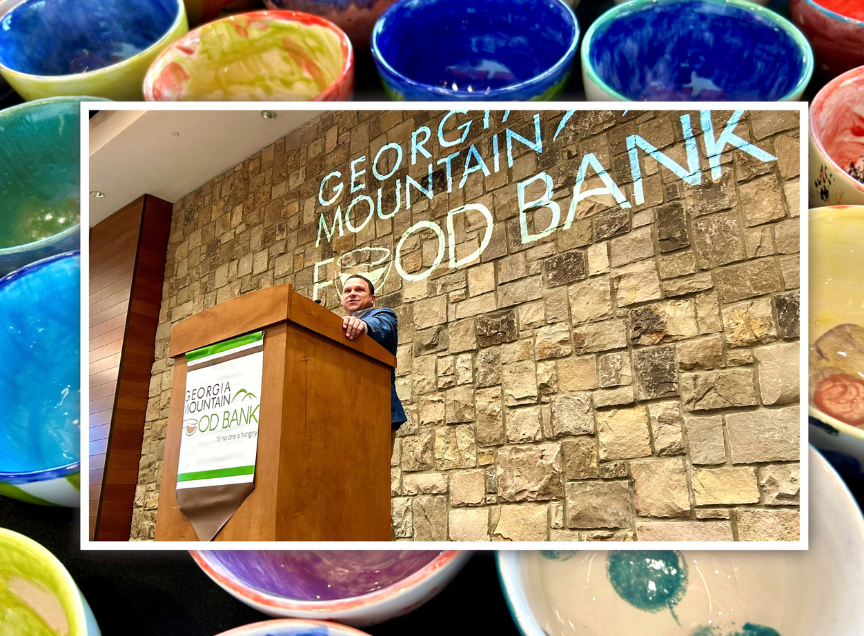

GAINESVILLE, Ga. — “If we care about food security, and we care about our families, we also have to care about farm security,” Tyler Harper, Georgia’s agriculture commissioner, said on Sept. 25 at the Georgia Mountain Food Bank’s 2026 Empty Bowl fundraiser luncheon that annually raises awareness of those in need in North Georgia.
Harper stressed the importance of strong, productive farms that produce the food that everyone relies on every day.
“Farm values, integrity and taking care of your neighbors, that is what today is about,” he said. “Empty Bowl represents many of our neighbors who are experiencing not knowing where their next meal is coming from, and that is what is special about today because you see a community that comes together to ensure that those bowls don’t stay empty.”
“Food insecurity isn’t just a big city problem,” Harper noted. “We actually have this issue in all 159 of our counties. As a matter of fact, one in eight Georgians experience food insecurity — a staggering statistic.”
He added that hunger oftentimes doesn’t look the way you might imagine. It can be a senior citizen on a fixed income, a working family struggling to make ends meet, a child who relies on school meals, or families who are hit with unexpected bills or a loss of income.
“What Georgia Mountain Food Bank does every single day is a perfect example of communities coming together to support each other,” Harper said. “Since 2008, this food bank has been able to provide 82 million pounds of food to Georgians in need in just this part of the state. That is remarkable!”
Georgia’s number one industry
Harper also described the importance of Georgia agriculture, not only in feeding the hungry, but to the state’s overall economy.
“Our state number one industry is agriculture. It’s what we do well; it’s the backbone of all of our economic engines in Georgia,” he said. “More than 370,000 Georgians are employed in this industry, an over $100 billion industry last year alone.”
“Our state is so agriculturally diverse,” Harper added. “You can go from apples in North Georgia, shrimp on the coast, peaches in Middle Georgia, to peanuts in South Georgia, to poultry all over the place, but really in North Georgia. Name another state where you can have an apple pie, a peach cobbler, a blueberry cobbler, fried shrimp, and peanut butter, all in the same meal. We grow almost 200 different commodities in our state. Agriculture is critically important; it is the backbone of who and what we do.”
He also connected how the business of farm families is vital to the supply of secure food.
“At the Department of Agriculture, we play a significant role in that every day,” Harper said. “To make sure that our farm families have the resources necessary to be successful, so that consumers have confidence in the marketplace, from convenience stores to grocery stores.”
“In addition, I’m proud of the relationships and the partnerships that we have built,” he noted. “We are feeding Georgia and supporting the food banks across this state.”
Through these connections between agriculture and hunger relief agencies, farmers are essential in the efforts to assist families in need, he added.
“If we work together to see that they both succeed, we can ensure that our state succeeds,” Harper said. “Government can’t solve hunger by itself, neither can our food banks, and neither can farm families. But you put all of us together — we can, and we can make a difference.”
“When you look at an empty bowl today, I hope you see what’s missing to put in that bowl to make sure that families are successful,” he noted. “I hope you see that farm that grew the food, the volunteer who packed a box, a donor who made it possible, and the food bank who made sure that it got to where it needed to go.”
“An empty bowl symbolizes hunger, but this room, all of you, symbolize hope,” Harper said. “And when our ag industry, when our food banks, when our businesses, our churches, our nonprofits, and our neighbors stand together, an empty bowl doesn’t stay empty. That’s the power of communities united against hunger.”
The Georgia Mountain Food Bank serves five counties in North Georgia. For more information, visit https://www.gamountainfoodbank.org.
