

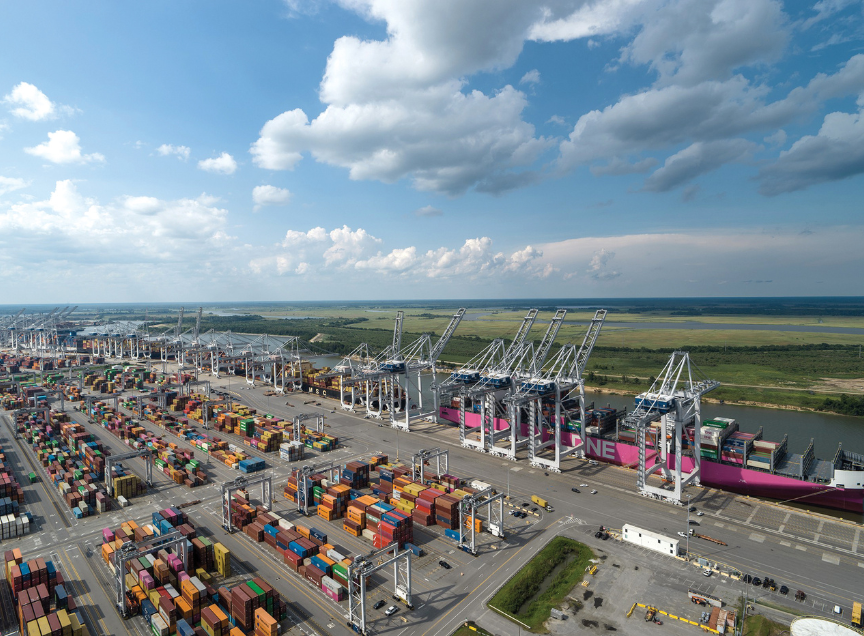

SAVANNAH, Ga. — Georgia’s ports support 605,616 full- and part-time jobs at Peach State businesses, yielding $44 billion in annual income, according to the latest study from the University of Georgia’s Terry College of Business.
“This report confirms what we’ve seen for years: our Ports are exceptional drivers of job creation and economic activity, both in the booming coastal region and in communities across Georgia,” Georgia Gov. Brian Kemp said in a statement. “As we continue to invest in these unrivaled assets statewide and our broader logistics network, we will build on the positive momentum of recent years and further promote opportunities for hardworking Georgians. On behalf of a grateful state, I want to congratulate and thank all those who work for the ports system for making this another record-breaking year of economic benefit.”
“Every shipment through Savannah and Brunswick fuels Georgia’s economy, supporting businesses, families and communities,” Griff Lynch, Georgia Ports CEO, said.
The Georgia Ports Authority is noted as the number one gateway for U.S. frozen poultry, handling approximately 37 percent of the nation’s frozen poultry exports.
Between FY2021 and FY2025, employment supported by port activity has increased by more than 44,500 jobs.
“Twelve percent of statewide employment, or almost one out of every eight Georgia jobs, is in some way dependent on the ports,” said Jeff Humphreys, director of the Selig Center for Economic Growth at the University of Georgia’s Terry School of Business, who conducted the study.
The total economic impact of Georgia’s ports increased 4 percent or $7 billion in FY2025, compared to the previous fiscal year.
Port activity now supports $181 billion in annual sales across the state, according to the UGA study.
“Ports are economic engines and our GPA employees and our valued partners in Gateway Terminals and the ILA are to be commended for their dedication and hard work contributing to Georgia’s strong economy,” Alec Poitevint, GPA board chairman, said.
Port customers, their suppliers and the businesses supported by port-user payrolls now account for 12 percent of Georgia’s total output, up from 11 percent in FY2024.
Business conducted through the ports also results in $10 billion in federal taxes, $3 billion in state taxes and $3 billion in local taxes.
The Port of Savannah is also the busiest gateway for containerized trade on the South Atlantic and Gulf Coasts, handling 5.67 million twenty-foot equivalent container units in FY2026, GPA said, adding that Savannah is one of the nation’s best-connected ports, offering 40 weekly vessel calls, direct interstate access and 42 trains per week to inland destinations.
