

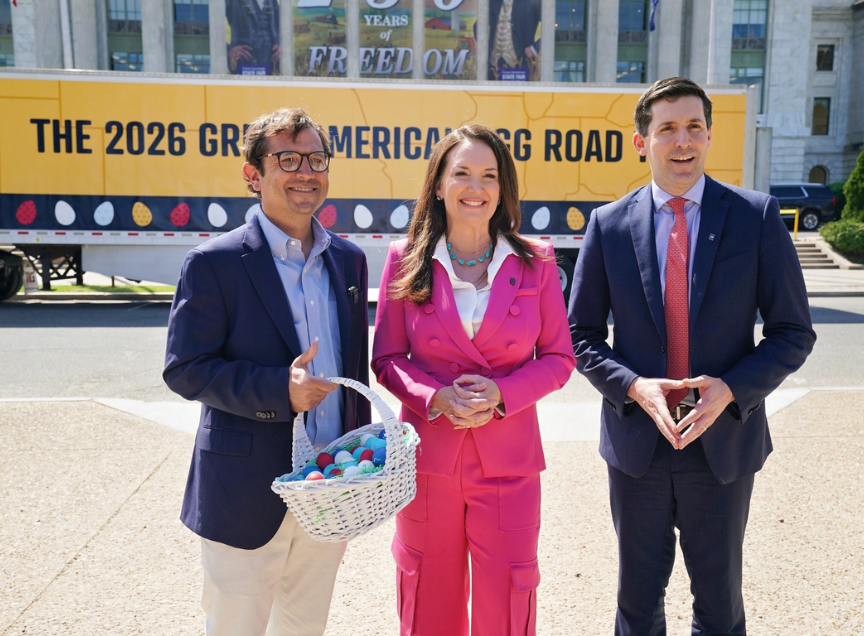

WASHINGTON — Just prior to the nation’s preeminent egg holiday, Easter, the American Egg Board, representing U.S. egg farmers, announced a $1 million investment to increase access to egg-based breakfast foods in schools.
AEB, along with senior federal government leadership of U.S. Agriculture Secretary Brooke Rollins, U.S. Health and Human Services Secretary Robert F. Kennedy Jr., and Calley Means, White House senior advisor, were all on hand to discuss how eggs can provide to nutritious breakfast meals in the nation’s school systems.
“America’s egg farmers are proud of the eggs we produce, and we are grateful to Secretary Rollins and Secretary Kennedy for their support of real food and America’s farmers,” Andrew Seger, AEB chairman and Wabash Valley Foods CFO, said. “We want to support our children in having a protein-packed breakfast that fuels them all day and promotes their brain development.”
“Eggs are the solution — and we are putting our money where our mission is,” Seger added.
A comprehensive effort for school meal programs to gain more access, more convenience and affordability of adding eggs to their menus is the goal of this $1 million investment, AEB added in the announcement. New recipes, a new partnership with school districts in planning egg-based pilot programs and looking at how schools can utilize existing cooking equipment in egg preparation are being developed.
AEB also noted that its Eggcelerator Lab will be developing new and affordable egg products that are specifically designed for school system kitchens.
“School districts need affordable, efficient, and easy-to-implement breakfast options to feed their growing populations, and eggs deliver on every count,” Emily Metz, AEB president and CEO, said. “This $1 million commitment is about unlocking new ideas, new partnerships, and new pathways to ensure more children can start their day with the high-quality protein they need.”
“The new Dietary Guidelines say it best: eat real food,” Metz added, “And eggs from America’s farmers are as real as it gets.”
Meeting dietary needs
Following the release of the Dietary Guidelines, protein-rich foods like eggs are at the top of the new pyramid, and AEB, along with food nutritionists, note that eggs are a healthy food that contribute to sustaining wellbeing.
“This is a perfect opportunity to highlight what an incredible source of protein eggs are for American families, especially as we’re rewriting what it means to eat real food and make America healthy again,” Rollins said in the announcement. “Eggs are as real as food gets — farm-fresh, completely natural, minimally processed and a source of eight essential nutrients. In the new Dietary Guidelines, eggs are listed first among the recommended proteins, and that’s a big deal.”
Sec. Kennedy also voiced his approval.
“We have flipped the food pyramid and eggs are up top,” Kennedy said. “Eggs are a wonderful, clean source of protein. They help kids with focus, brain development, eye health, and two eggs are cheaper than the donut kids get in schools. This is a wonderful source of American-made protein for the American table and we are very, very proud to be part of this effort.”
“With the food pyramid, we started asking common-sense questions like, ‘Can we get more high-protein, whole foods into government procurement programs such as school lunches and military meals?’” Means said. “Right now, it’s true that children are not getting whole-food, high-protein breakfasts.”
“Hard-boiled eggs and innovations like egg bites can be at the same price or lower than the food we’re currently serving our children,” Means added.
Donation drive
The school meal announcement was also an opportunity to celebrate a successful egg donation drive that occurred nationwide with AEB in partnership with HATCH.
In the two weeks leading up to Easter, this egg donation initiative provided more than 9.7 million eggs to food banks across the U.S.
“Eggs are one of the most requested and most impactful foods we can provide,” Metz said. “This effort shows what’s possible when farmers, nonprofits, and government work together to close the protein gap.”
