

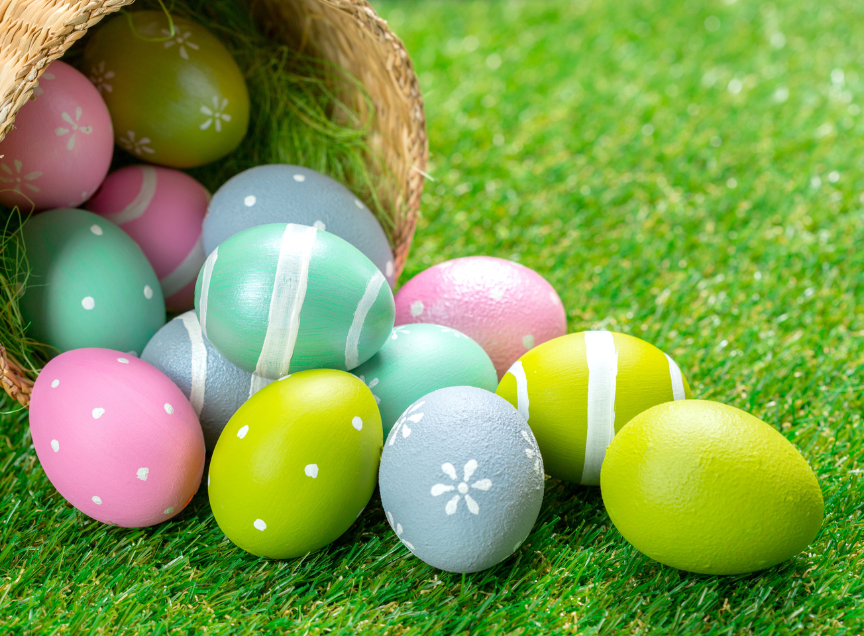

GAINESVILLE, Ga. — Spring is upon us and, naturally, the first holiday you think of is Easter. Easter is a Christian holiday that celebrates the resurrection of Jesus Christ, but, in modern times, the holiday has quickly become associated with non-religious symbols, such as bunnies, candy and eggs.
In fact, there is little known about the origins of the Easter Bunny or the tradition of decorating eggs, but both have quickly become synonymous with Easter.
So, how is it that eggs became a symbol of such a religious holiday?
The egg has been a long-time, universal symbol of new life, fertility, and restoration, established in pre-Christian and pagan traditions. According to Britannica, European pagans viewed eggs as a symbol of the regeneration that comes with springtime.
Early Christians adopted this imagery to represent Jesus’ emergence from the tomb and resurrection, according to History.com.
As for the decoration of Easter eggs, although the origins are unknown, the actual tradition dates to at least the 13th century and has been practiced in Eastern Orthodox and Western churches. In the past, churches forbade the eating of eggs and other animal products during Lent and the Holy Week as a symbolic abstinence to represent Jesus’ 40-day fast.
However, hens still produced eggs during this time. So, to prevent waste, people would paint and decorate the eggs, then eat them on Easter in celebration of the holiday and the end of the period of penance and fasting, according to History.com.
According to Britannica, in the Orthodox tradition, eggs are painted red to symbolize the blood that Jesus shed on the cross. Although we now have plastic, colored eggs, there’s no need to physically dye them, although that is also a fun option. Colorful eggs have remained a key part of Easter.
Not only are the eggs themselves important to Easter, but so are egg-related activities, such as egg hunts and egg rolling. Easter egg hunts can vary in size and location, but it’s a wholesome Easter tradition that can be fun for all ages.
Egg rolling is exactly what it sounds like: people rolling hard-boiled, decorated eggs down a hill to see whose egg travels the farthest or survives the longest without breaking. Among the largest egg rolling events is the annual White House Easter Egg Roll.
The White House Easter Egg Roll is a giant egg rolling event for kids that takes place on the White House South Lawn and dates to 1878 during Rutherford B. Hayes’ presidency. The event has taken place every year since, except for during World War I and II and the COVID-19 pandemic, according to the White House website.
So, this Easter Sunday, while you’re eating, hunting for, or rolling your eggs, take a moment to think about how this poultry product became so intertwined with the holiday.
