


ATLANTA — Poultry houses are a significant part of the poultry farming process. From conventional cages to free range, each housing system affects birds’ behavior and well-being differently.
However, a team of engineers from the Georgia Institute of Technology are working on a project that will improve all poultry housing in a way that benefits the birds and the farmers who care for them.
“We are developing technologies that take a fresh look at poultry housing and see how poultry house operations can be done more efficiently and better for [the] environment, better for [the] birds, better for bird well-being and welfare, and produce economic benefits for the farmer and industry as well,” Alex Samoylov, principal research scientist at the Georgia Tech Research Institute and project director, said.
The project, entitled “Poultry House of the Future,” is focused on removing chicken waste, minimizing the moisture in the air in a poultry house, and optimizing the amount of conditioned air in the house.
Samoylov and his team decided to focus on these three things because temperature, odor, and moisture are three significant daily challenges for farmers that can impact bird well-being and growth rates.
“There are a couple of things that we are addressing that the industry is struggling with,” Samoylov said. “[The] environment in [a] house is very difficult to control. There’s a lot of moisture content that’s coming from different sources, including the birds themselves. Technologies that we are working on are trying to minimize [the] amount of moisture that actually stays in the house.”
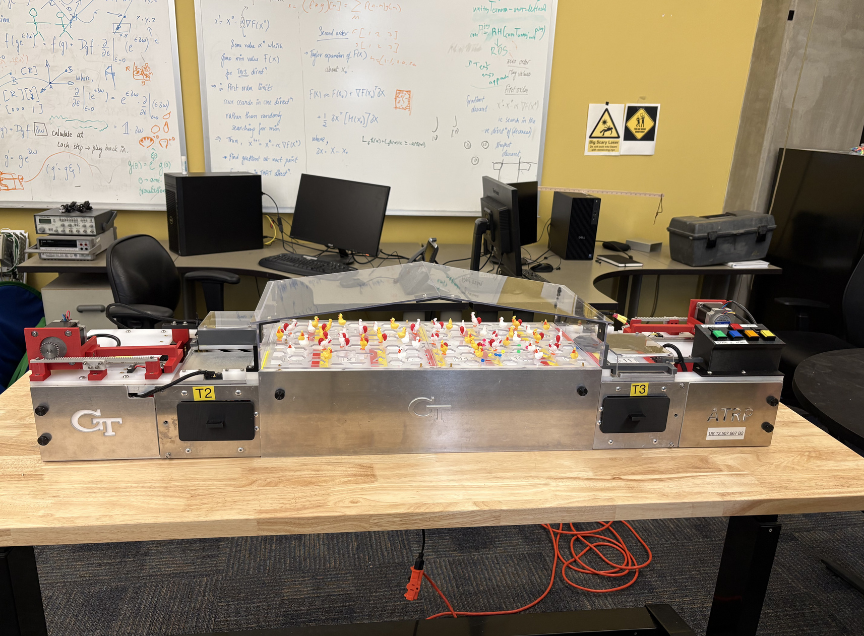
One part of the project that addresses this moisture problem is the Broiler House Integrated Guided-Motion Excreta Saturation System (BHIG-MESS). BHIG-MESS is a raised tile flooring system that automatically removes chicken waste from the house on a regular basis.
With this system, the birds’ waste is being collected in trays sitting underneath the floor tiles. These trays are moving on a conveyor belt that carries the waste outside of the poultry house, where it is then properly disposed of, keeping the inside of the poultry house dry and clean.
“It’s a very simple system. [At Georgia Tech,] we do a lot of complex work, but here we intentionally wanted to not do a super complicated system so farmers can easily maintain it,” Samoylov added. “The idea behind all of it is that we’re not trying to put extra work on the farmer; we’re not trying to create extra headaches. We’re actually trying to make their work easier.”
‘Chicken Bubble’
The second part of the “Poultry House of the Future” is the Chicken Bubble. The Chicken Bubble addresses the temperature challenge by optimizing the amount of conditioned air in the house.
“Other technologies that we are working on is trying to displace [the] air inside of a house in a way that our air conditioning requirements are … reduced,” Samoylov said. “Venting takes a lot of energy, and energy is one [of the] single biggest expenses for a farmer, so by reducing the energy demands, we help farmers financially.”
The concept behind the Chicken Bubble is that chickens only need a small portion of the air that fills an entire chicken house; the rest is essentially being wasted. This in turn means that the money spent to condition the extra air is being wasted as well.
So, the Chicken Bubble will use a balloon to reduce the amount of air that needs to be conditioned, but the chicken house will still be comfortable for the birds. The Chicken Bubble will also help farmers during the winter because the system can apply to heating air as well.
Samoylov and his team have the long-term goal of commercialization for this project, and field trials are a big part of the process to get the Poultry House of the Future to the public. A seemingly unlikely ally is helping this team of Georgia Tech engineers reach this goal: University of Georgia’s College of Agricultural & Environmental Sciences.
“Georgia and Georgia Tech fight on the football field … one day a year, but 364 days a year, we’re actually working together quite closely,” Samoylov noted. “I’m very grateful for [our] partnership with UGA. Georgia Tech does not really have [a] college of agriculture, we’re all engineers. So, to do agriculture work, [we] need to partner with universities that have land grants, experimental farms, [and] access to live birds.”
Samoylov specifically thanked Dr. Brian Fairchild, a UGA poultry science professor, who has been a big help with this project as a project collaborator with UGA’s Department of Poultry Science.
In the field trials they’ve already run, the results showed that the chickens raised on the BHIG-MESS flooring system had less cases of footpad dermatitis, a condition caused by wet and dirty litter, and showed similar weight gain patterns to birds raised on traditional litter.
While Samoylov and his team are nowhere close to commercialization, the Poultry House of the Future project is making tremendous progress.
“This is the second year of [our] large-scale project,” Samoylov explained. “We are still trying to engineer a system and come up with engineering requirements that would be applicable to large-scale applications. We will engage with manufacturers for a design for a manufacturability study to select scalable materials, and hardware, ensuring the solution is practical and commercially viable.”
The team applied for two U.S. patents in 2024, one for the BHIG-MESS and another for the Chicken Bubble, according to the Georgia Tech Research Institute.
