GAINESVILLE, Ga. — Every industry is looking into how to incorporate artificial intelligence technology into existing business functions, and poultry processing is no exception.
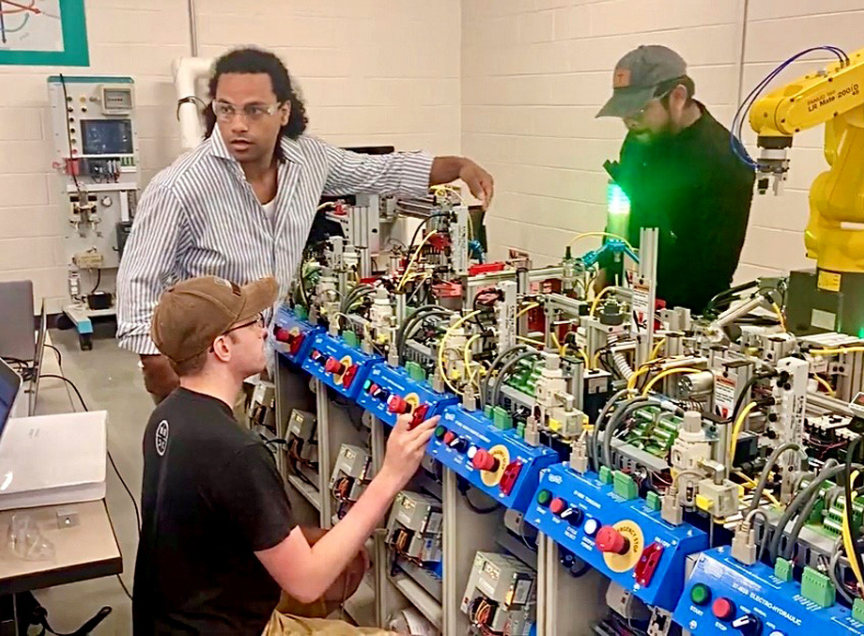
Lanier Technical College in Gainesville, Ga., is reaping a tremendous opportunity through a state funded grant program where students are using AI and automation to simulate the functions of poultry and food processing.
Poultry Times recently visited the Lanier Tech campus to learn more about the Georgia AIM (AI Manufacturing) Grant, and how students are currently seeking to complete the school’s Automation Technical Certificate of Credit (TCC), and also how this technology can be used in several production sectors, specifically poultry processing.
“Thank goodness we’ve got this grant that’s allowed us to purchase equipment to teach our students,” Chad Faircloth, Lanier Tech’s Industrial Systems Technology & Mechatronics Technology Program director, said. “On the automation side, we’re trying to add AI in the visual systems that’s involved, and we’ll see, hopefully, in the poultry industry that it will make better production for their plants.”
With these vision systems, Faircloth noted that as it is applied to such tasks as cutting a chicken breast, it looks at the size of the cut, what is cut, and if the cut was made well.
In looking at AI application, it checks size, and it also, “checks the weight, but as it’s taking pictures, if there is something involved or something in the chicken breast that is not wanted, it could obviously pick it out or reject it,” he said.
As this is a new program, with approximately 20 students starting out, the college is looking into what classes and training will be most beneficial to its students, as well as the poultry industry, Faircloth added. But with completion of the program, he believes that the job market is wide open for the students.
“I could place these students anywhere really, and not just in the poultry industry,” Faircloth said. “AI is coming along so quick in all our production industries that these students have jobs before they graduate. It teaches these students skills in all automation industries. It’s not just subject to one area.”
In addressing some of the tasks and future tasks that the students are learning, Faircloth added, “If you look at the TCC we have put together for them, they’re learning anything from basic electrical to intermediate electrical programming … to the AI side and automation. And that is where we want to see this industry go is the automated side to where they’re pushing a button and the program’s taking care of itself. But we’re trying to train these students to make sure that they can troubleshoot and fix the problems that’re going to arrive with these systems.”
Do the Lanier Tech students primarily work with computers, or is there direct work with robots and machinery?
“It’s a little bit of both,” Faircloth added. “I mean the first thing is getting the equipment set up, which is getting the robot set up completely. Once it’s set up and running it should be pretty much on its own, but as you know, there’s always going to be problems and that’s where they come in and they’re hands-on troubleshooting or programming and fixing it.”
Lanier Tech noted in an announcement about Georgia AIM that its program is focused on the application of AI automation that will simulate poultry and food processing in its “remote plant operations studios.”
“The college was very fortunate to be included in the Georgia AIM Grant, which has brought multiple benefits to the college and community,” Tim McDonald, Lanier Tech president, said in the announcement. “By integrating this new technology, the college has strengthened its partnerships with local food processors and manufacturers. It has also enhanced our collaborative relationships with our sister technical colleges and broadened the scope of training for our Mechatronics program.”